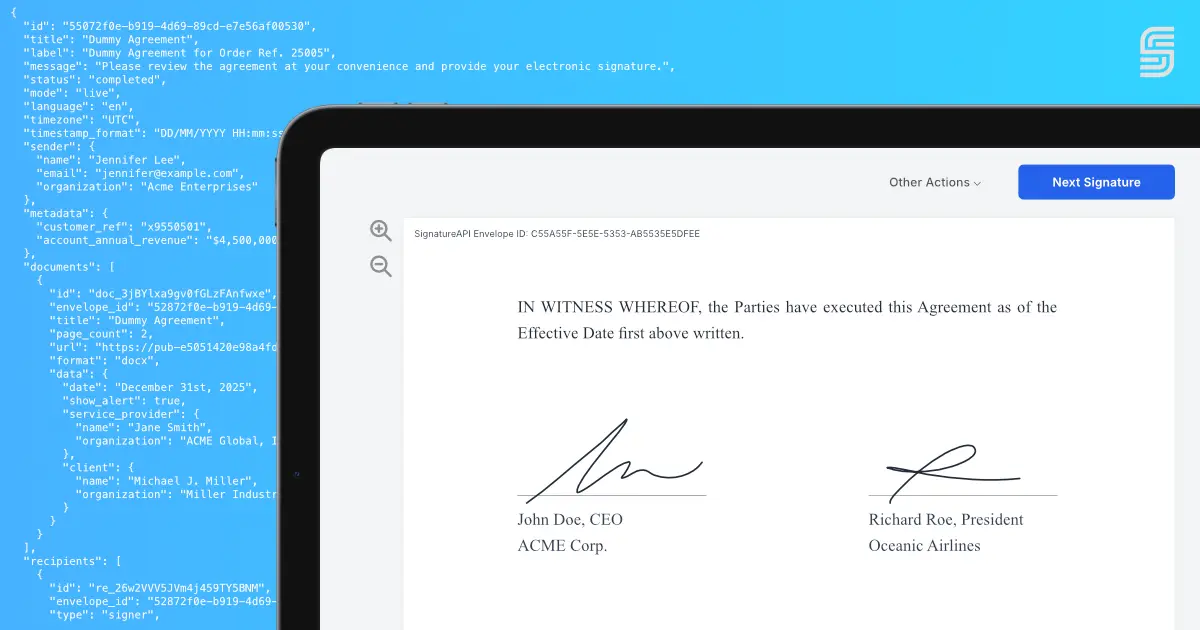
Compliance certifications like SOC2 and ISO require annual privacy policy reviews. Most companies don’t have a legal team for this. They hire lawyers from Upwork charging $1,000 to $2,000 per hour. For a policy review that takes a few hours, that adds up fast.
I saw this problem firsthand while working on SignatureAPI’s compliance. The process was expensive and slow. There had to be a better way.
The Service
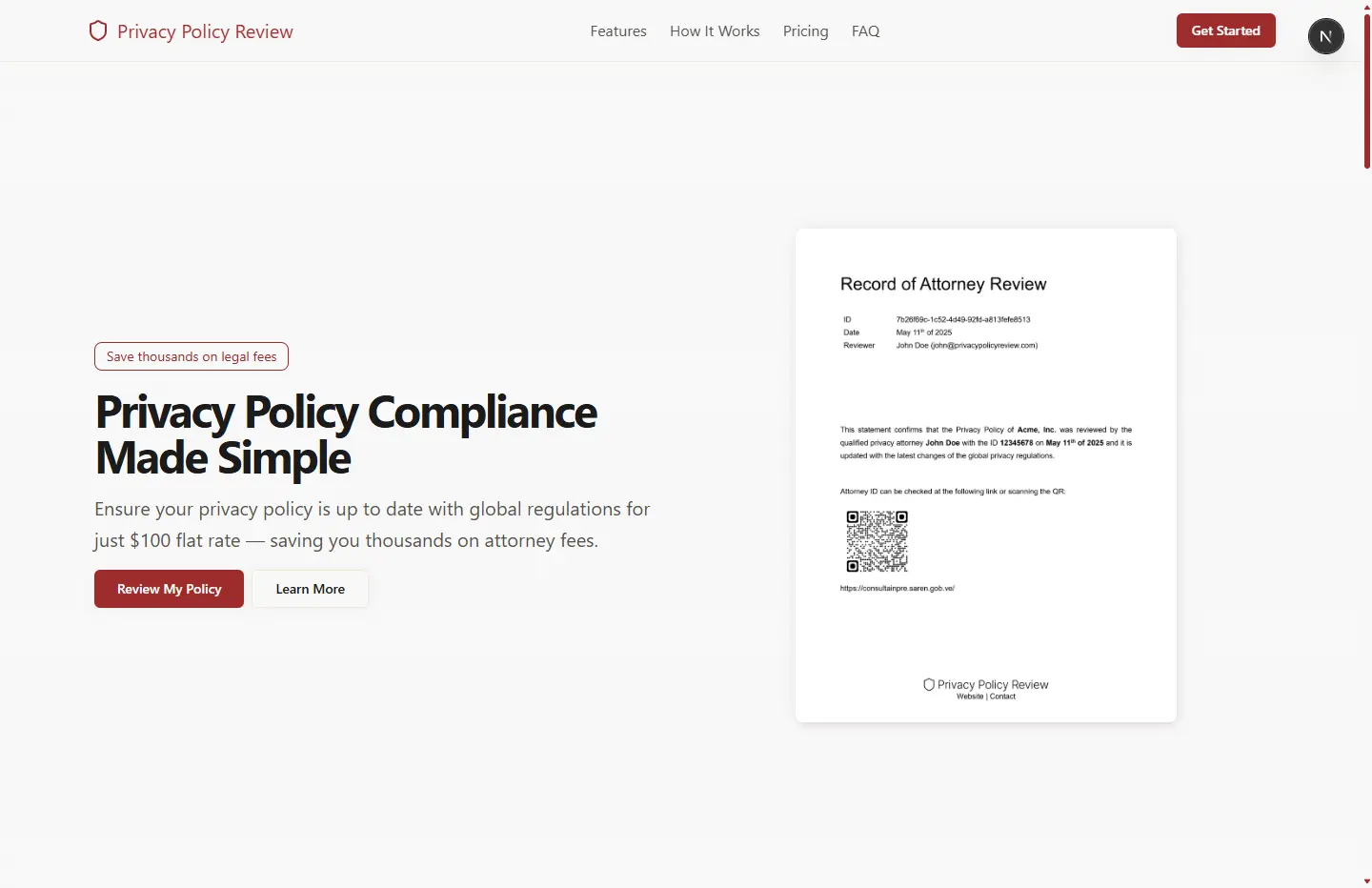
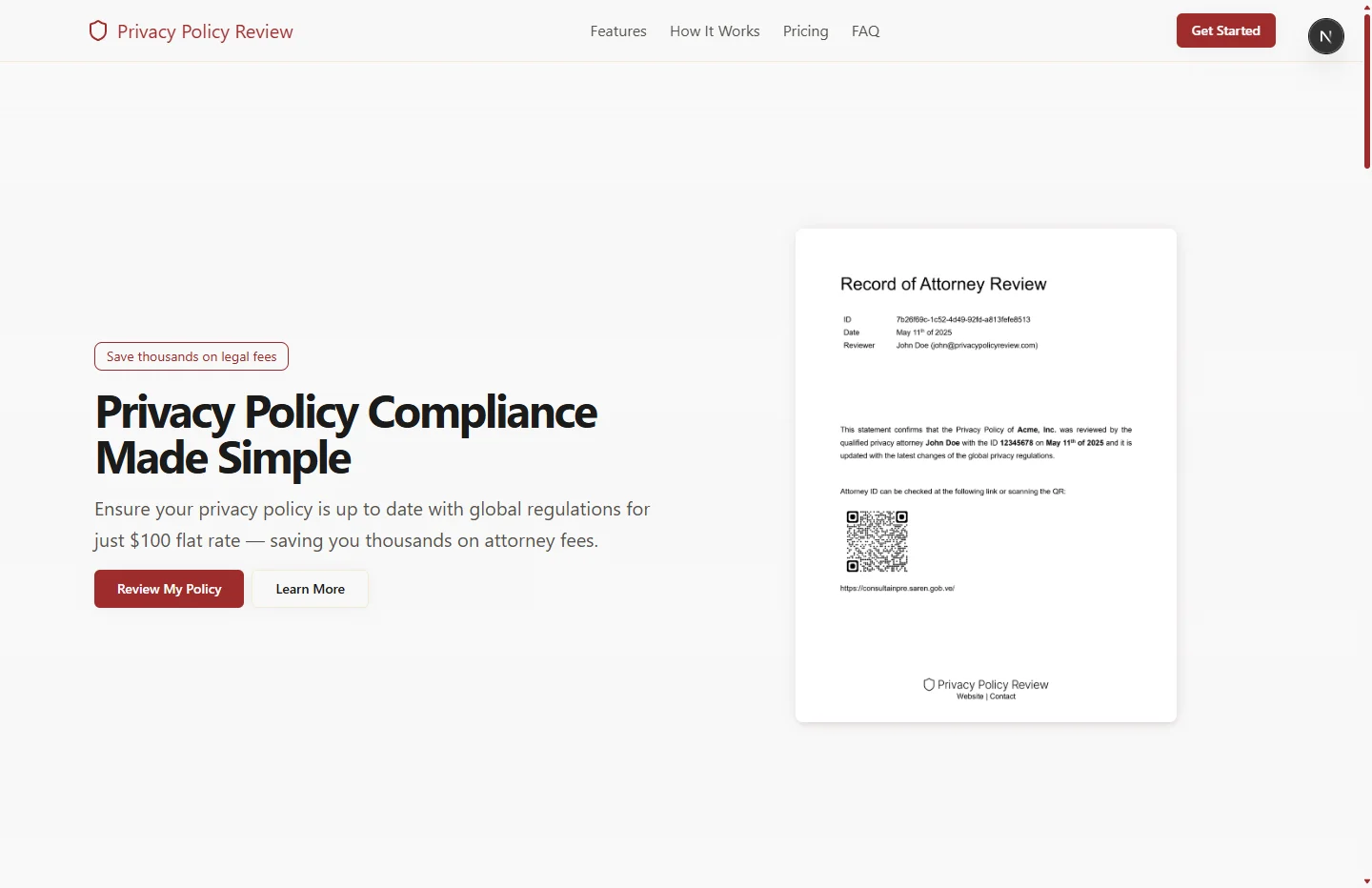
Privacy Policy Review offers a flat rate of $100 per review. No hourly billing, no surprise costs. You submit your privacy policy, and attorneys review it against global regulations.
The output is a detailed report covering:
- GDPR compliance gaps
- CCPA requirements
- Industry-specific regulations
- Missing clauses and disclosures
- Recommended changes
Architecture
The platform runs on Next.js 16 with Turbopack for fast development. The backend uses Convex, a real-time database that handles both storage and serverless functions.
The application is organized into two main areas: marketing pages for the landing experience and dashboard pages for the core application. The backend logic lives separately, handling the data model, policy submissions, document management, and user notifications. Documentation is built with Fumadocs.
Data Model
The system has three user roles: clients who submit policies, attorneys who review them, and admins who manage the platform.
Submissions are the core entity, tracking each policy through its lifecycle. A submission moves through several states: processing, AI review, payment, attorney review, changes requested, and final approval. Each submission links the client, optional assigned attorney, company details, and uploaded document. An AI compliance score is calculated during the preprocessing phase.
Review Workflow
The review process has multiple stages:
- Upload: Client submits a privacy policy document
- AI Processing: The document is parsed into review units (clauses, definitions, disclosures)
- Payment: Client pays the flat fee
- Assignment: Admin assigns an attorney
- Review: Attorney examines each unit, adds comments
- Resolution: Client addresses feedback, attorney approves
Breaking the policy into units lets attorneys focus on specific sections. Each unit is classified by type (header, clause, definition, rights, disclosure) and includes AI-generated analysis with compliance flags, concerns, suggestions, and a risk level. Units track their own review status as they move from pending through approval or change requests.
AI Preprocessing
The AI layer handles the tedious work:
- Document Parsing: Extracts text from PDFs and identifies section boundaries
- Unit Classification: Categorizes each section (clause, definition, disclosure, etc.)
- Compliance Analysis: Flags potential GDPR, CCPA, and other regulation gaps
- Risk Assessment: Assigns low/medium/high risk levels to each section
- Suggestions: Generates initial recommendations for improvements
This gives attorneys a head start. Instead of reading through everything, they see a pre-analyzed document with issues already highlighted.
Attorney Review Interface
Attorneys see a structured view of the policy. The interface fetches all review units for a submission, ensuring only authorized attorneys can access the data.
Each unit displays:
- The original policy text
- AI-generated compliance flags and suggestions
- Risk level indicator
- Space for attorney comments
- Approve/Request Changes buttons
Comments and Feedback
Attorneys add structured comments to each review unit. Each comment is linked to a specific unit and author, with content and a status (open or resolved).
Comment types distinguish between suggestions (nice to have), required changes (must fix), approvals, and notes (FYI). This clarity helps clients prioritize fixes.
Revision Tracking
Clients can submit revised policies. The system tracks each revision with a version number, the uploaded document, and metrics showing how many units changed, were added, or removed.
Each revision shows what changed. Attorneys can quickly see if the client addressed the required changes without re-reviewing the entire document.
Notifications
Svix handles webhook delivery for notifications. The system notifies users at key moments:
- AI review complete
- Attorney assigned
- Changes requested
- Review approved
- Payment received
Notifications are stored per user with a type and status (unread, read, or archived) to track engagement.
Why Convex
Convex made the real-time features easy. When an attorney adds a comment, clients see it immediately without polling. The subscription model keeps everyone in sync through simple React hooks that subscribe to database queries.
The serverless functions run alongside the database queries. No separate backend to deploy and maintain.
Authentication
Clerk handles user management. The middleware protects routes based on user roles, with helper functions that verify the current user has attorney or admin access before allowing sensitive operations.
Attorneys and admins see different dashboards than clients. Role-based access is enforced both at the UI and database query levels.
What I Learned
Hybrid AI + human workflows are powerful. AI handles the tedious parsing and initial analysis. Humans provide the legal expertise that AI can’t reliably deliver.
Convex’s real-time capabilities simplified the collaborative review process. Building the same with a traditional REST API would have required much more code.
The flat pricing model changes the dynamic. Clients know the cost upfront. Attorneys can focus on quality instead of billing hours.
Privacy Policy Review — Reviewed by AI, Verified by an Attorney
Get your privacy policy reviewed against SOC 2, GDPR, HIPAA, CCPA, ISO 27001, and PCI DSS. AI-powered analysis verified by an attorney. Flat $199.
If you’re preparing for a compliance audit, getting your privacy policy reviewed is one less thing to worry about.