Software Developer
My responsibility was to develop new functionalities for the customer portal for Daycohost, one of the largest data centers in Venezuela. My tasks were views creation, backend development and integration between web services.
Rebuilding a data center’s customer portal
Daycohost is one of the largest data centers in Venezuela. It hosts important systems for banks and businesses.
In 2020, its customer portal was outdated and hard to use. Customers had problems with it, and so did developers.
I joined the team at Consultores UCAB to rebuild it. We wanted it to be modern, fast and easier to use. I started in March 2020 as a Junior Consultant and Software Developer. In August 2020, I became a Semi Senior Consultant. I stayed until October 2021.
Old systems we kept
This was not a simple project. We could not start fresh, because we had to work with old systems that had been running for years.
The new portal had to connect to old backend systems that had little documentation. My job was to make the modern website work with that old backend.
I spent weeks figuring out how these systems worked. I analyzed their SOAP responses. SOAP is an older way for systems to exchange data as XML messages. Then I built a translation layer with NestJS, a framework for building servers in TypeScript. This layer took messy data from the old systems and turned it into clean data that the new website could use.
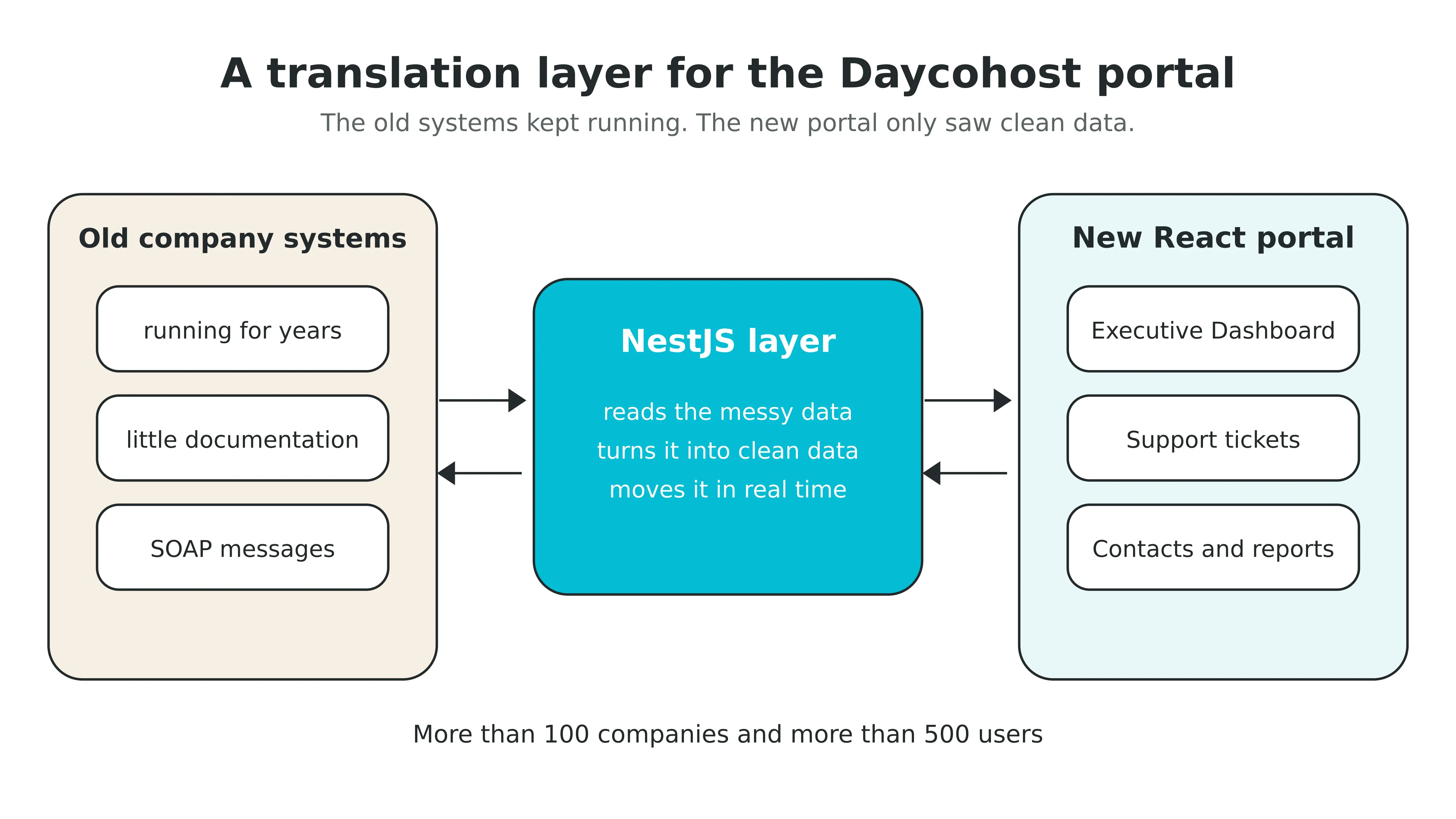
Those integrations connected the company’s enterprise systems to the portal. Data now moved between them in real time, and people had to type much less data by hand.
A faster portal
For the frontend, we used React. This was a big change from the old portal, which reloaded the whole page every time you clicked something. We built a Single Page Application, a website that updates only the parts that change. It felt much faster.
We started from the first version the consultancy had created, and I kept developing it with NestJS and React. The stack also included Next.js, TypeScript and Redis. Redis is a very fast in memory database that is often used as a cache.
I built the Executive Dashboard. It is the main screen customers see when they log in. It showed live information about their servers, the status of their services and billing alerts, all in one place. It had to be fast and accurate.
I also built the Support Ticketing System. When customers report a problem at a data center, it is urgent. I made sure that a critical issue went directly to the right team at Daycohost. That made response times much faster.
Other views followed, like contact management, reporting and requests. I also developed the backend services behind them.
Consulting, not only coding
Consultores UCAB is a consulting firm, so the job was more than writing code. I sat in requirements sessions with Daycohost’s stakeholders. I turned their business processes into technical specifications, and I guided the integrations with their existing systems.
I worked with the client and the product team on business analysis and requirements. I also led the development team, to make sure we reached the project goals. And I worked closely with other departments, so the portal met the needs of both the customers and the company.
Those conversations shaped the product more than any framework choice. When you understand why a bank needs a report at 8 a.m., you build a very different portal.
Deployments in 5 minutes
When I joined, releases were manual. Each deployment took 1 to 2 hours, and it depended on someone doing every step in the right order. Mistakes happened.
Nobody asked me to fix this. I proposed and built the team’s first automated deployment pipeline anyway. I automated the repeated development tasks and created Docker images for development. A Docker image packs an app with everything it needs, so it runs the same way on every machine. Deployments went from 1 to 2 hours down to 5 minutes, and human error disappeared from the release process.
This was the start of a DevOps culture in the team. DevOps means developers and operations work as one team, with automation in the middle. The portal served more than 100 companies and more than 500 users, so every safe deployment mattered.
What I learned
This project taught me that you cannot always start from scratch. Sometimes you have to work with old code that already runs important systems.
Good engineering means building modern tools that work with old systems without breaking anything. We gave Daycohost’s customers a much better experience, and all their critical systems kept running.