Problem-Solving Like a Pro
My seven step method for problem solving, in code and in life: find the root cause, break the problem down, compare solutions, pick a strategy, and reflect.

“My code is slow” sounds like a problem. It is only a symptom. The real problem may be an O(n^2) loop over a huge dataset, a loop that gets four times slower each time the data doubles.
Some days life feels like an endless stream of error messages. But what if every problem was a chance to level up? Here is how I solve problems without losing my mind.
Why this skill matters
Problem solving is a life skill, not only a work skill. It helps you debug code and fix a leaking faucet. It also teaches you that obstacles are temporary and can be beaten.
My seven steps
Enough philosophy. This is my playbook.
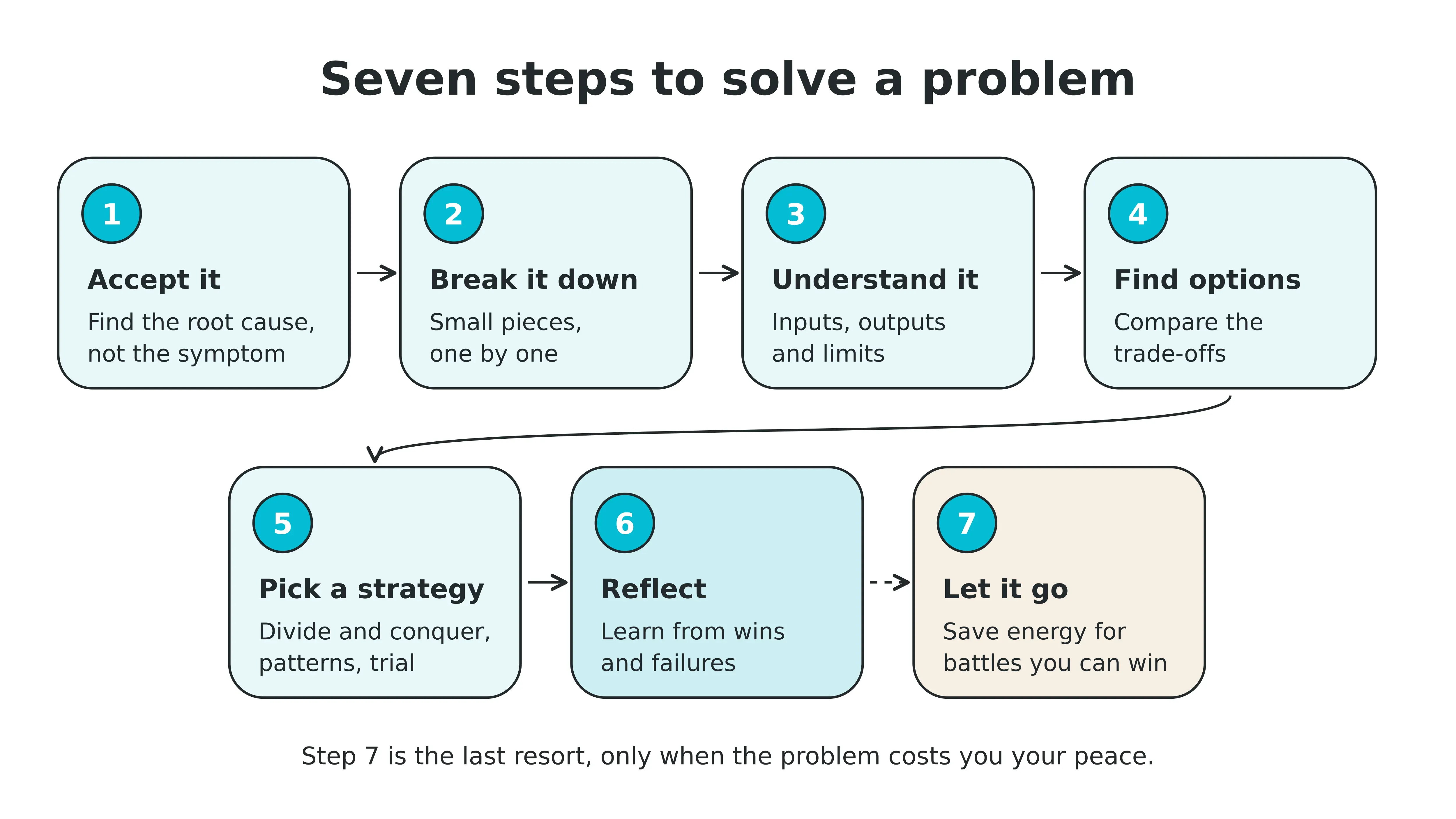
1. Accept the problem
Do not deny the problem or put it off. Face it. Then look deeper. Are you seeing the problem, or only the symptoms?

In the slow code example, the loop is the problem. Dig until you find the root cause.
2. Break it down
Big problems are scary. Small problems are easy.
So cut the big problem into pieces. Find the critical path (the chain of steps that decides how long everything takes), the bottlenecks and the dependencies. Solve the small pieces one by one, and the big problem is gone.
3. Understand it first
Collect information. What goes in? What should come out? What are the limits? You cannot fix what you do not understand.
4. Find many solutions
Do not fall in love with the first idea in your head. It is usually not the best one.
Think of several options. Is option A faster but riskier? Is option B slower but safer? Weigh the trade-offs.
5. Choose a strategy
Complex problems need a strategy. Divide and conquer means you split the problem and solve each part alone. Trial and error means you try, fail and try again. Pattern recognition means you look for problems you have seen before. Pick the right tool for the job.
(I will write a whole post about algorithm strategies later.)
6. Reflect on it
If you fail, learn. If you succeed, learn.
Thinking about how you solved a problem is as important as solving it. It fills your memory with solutions for next time.
7. Let it go
Sometimes you cannot solve it, and that is okay. If you tried everything and it is costing you your peace, it may be time to walk away.

Letting go is not quitting. You are choosing where to spend your energy. Save it for battles you can win.
Every problem is practice
Accept the challenge, break it down, understand it, and do not be afraid to change direction. The next error message is just another level.
If you enjoy the content, please don’t hesitate to subscribe and leave a comment! I would love to connect with you and hear your thoughts on the topics I cover.
Interested in working together? Check out my services and pricing to see how we can collaborate on your next project. Let's Build